

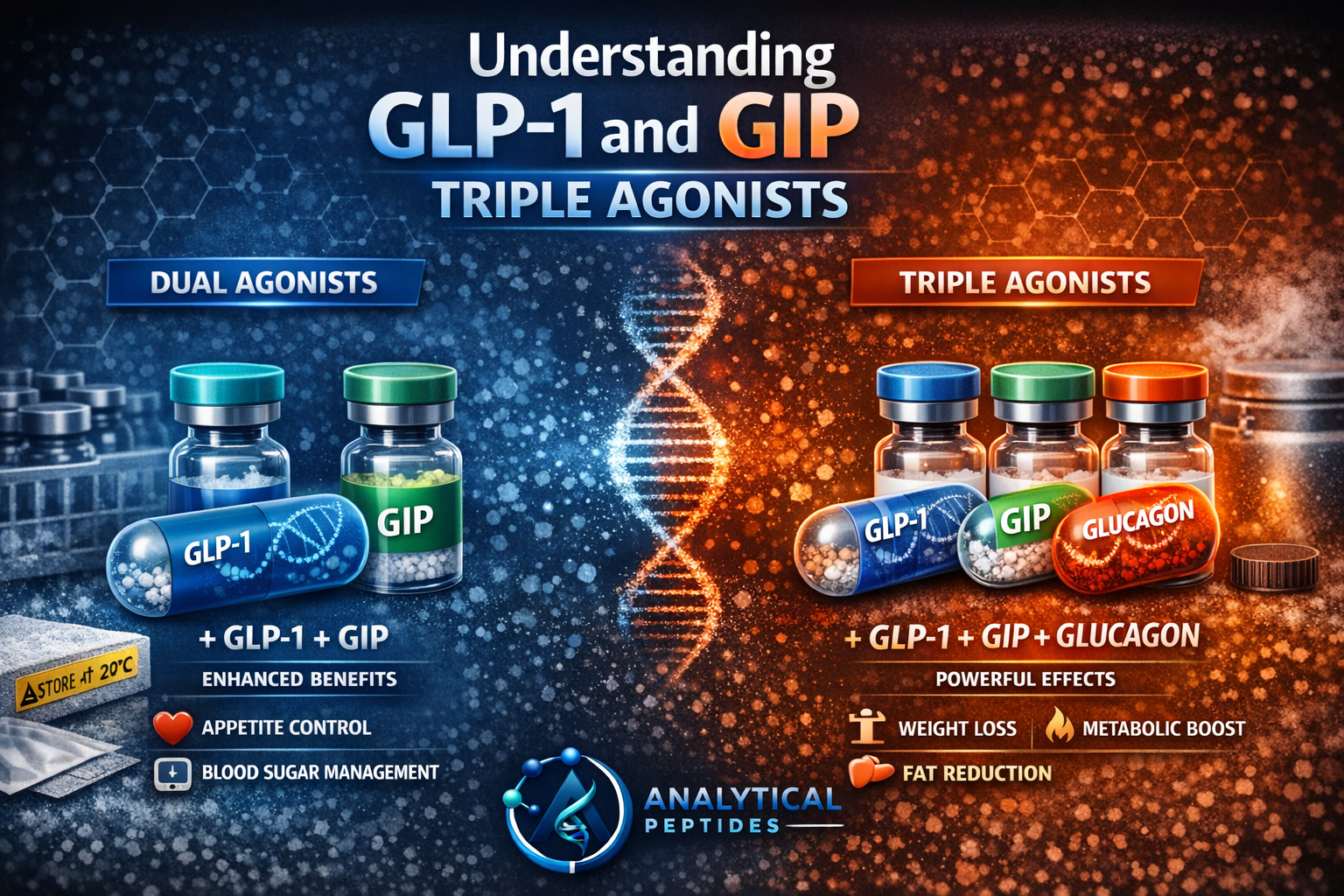
Understanding GLP-1 and GIP Triple Agonists – The Shift to Poly-Agonist Pharmacology
The field of metabolic research has transitioned from single-hormone therapies to a complex “systems pharmacology” approach. While the previous generation of research focused on single GLP-1 (Glucagon-Like Peptide-1) agonists, the year 2026 marks the rise of triple agonists—multi-receptor peptides designed to address obesity and metabolic dysfunction through three distinct yet complementary biological pathways.
At Analytical Peptides, we provide the high-purity compounds necessary for researchers to investigate how these “GGG” (GLP-1/GIP/Glucagon) agonists compare to traditional dual-agonist or single-agonist protocols.
1. The Triple Mechanism of Action
Triple agonists represent a pharmacological breakthrough by pulling three metabolic levers at once. Each component of the peptide sequence is engineered to provide a specific physiological outcome:
- GLP-1 (Glucagon-Like Peptide-1): Primarily functions by reducing appetite through action on the central nervous system. It slows gastric emptying to increase satiety and facilitates glucose-dependent insulin secretion.
- GIP (Glucose-Dependent Insulinotropic Polypeptide): Works synergistically with GLP-1 to enhance insulin response. It is also critical for adipose tissue health, potentially promoting lipid clearance and mitigating the gastrointestinal distress often associated with pure GLP-1 agonists.
- Glucagon (GCG): The “powerhouse” addition to the triple agonist. Unlike the other two, Glucagon increases energy expenditure and stimulates lipolysis—the direct breakdown of fat.
2. Overcoming the Glucagon Challenge
Historically, Glucagon was avoided in weight-loss research because it can raise blood sugar. However, in triple agonists, the insulin-stimulating effects of GLP-1 and GIP effectively “buffer” or balance the glycemic rise. This allows the researcher to harness the thermogenic (calorie-burning) benefits of Glucagon without the negative side effect of hyperglycemia.
3. Case Study: Retatrutide (LY3437943)
Retatrutide is the primary triple-agonist candidate in 2026 research, currently undergoing Phase 3 clinical trials such as TRIUMPH and TRANSCEND-T2D.
Key 2026 Research Benchmarks:
- Superior Weight Reduction: Phase 2 data revealed average weight loss of up to 24.2% at 48 weeks, a threshold previously only seen in bariatric surgery.
- A1C Optimization: Studies have shown A1C reductions as high as 2.16% over 36 weeks.
- Liver Health Focus: Due to the Glucagon component, researchers are seeing significant reductions in liver fat, making it a key compound for studying MASH (Metabolic Dysfunction-Associated Steatohepatitis).
4. Advanced Molecular Design and Stability
Designing a single peptide to activate three different receptors requires extreme precision in amino acid sequencing. Retatrutide, for example, is a 39-amino acid peptide that has been modified with a fatty acid side chain.
Research Implications:
- Half-Life: The structural modification extends the half-life to approximately 6 days, allowing for a once-weekly research protocol.
- Structural Integrity: Triple agonists are highly sensitive to pH and temperature; improper storage can lead to the “denaturation” of these complex sequences.
5. Evaluating Side Effects and Tolerability
As with any incretin mimetic, triple agonists present specific side effects that researchers must monitor:
- Gastrointestinal Distress: Nausea and vomiting remain the most common observations, typically occurring during dose-escalation phases.
- Heart Rate Variations: Because Glucagon can activate the sympathetic nervous system, some research subjects have shown a transient increase in heart rate.
6. The Future of Metabolic Research
The goal of triple agonist research in 2026 is to provide a pharmacological alternative to invasive surgeries for severe obesity and metabolic comorbidities. By “reprogramming” metabolic pathways through three receptors simultaneously, these peptides represent the current pinnacle of synthetic peptide engineering.
7. Analytical Quality Control for Triple Agonists
Given the complexity of the 39-amino acid sequence, researchers must verify their compounds via:
- High-Performance Liquid Chromatography (HPLC): To confirm a purity level of $>99\%$.
- Mass Spectrometry (MS): To ensure the molecular weight perfectly matches the intended triple-agonist sequence.
Conclusion: The New Gold Standard
Triple agonists like Retatrutide are redefining what is possible in endocrinology and metabolic science. At Analytical Peptides, we are committed to providing the precision-engineered compounds required to explore this new frontier of receptor synergy.
Research Notice: All products mentioned, including GLP-1/GIP/Glucagon triple agonists, are intended strictly for laboratory research purposes only. Not for human consumption or therapeutic use.