
Peptide Reconstitution Guide for Researchers – Understanding Peptide Reconstitution in Research Settings
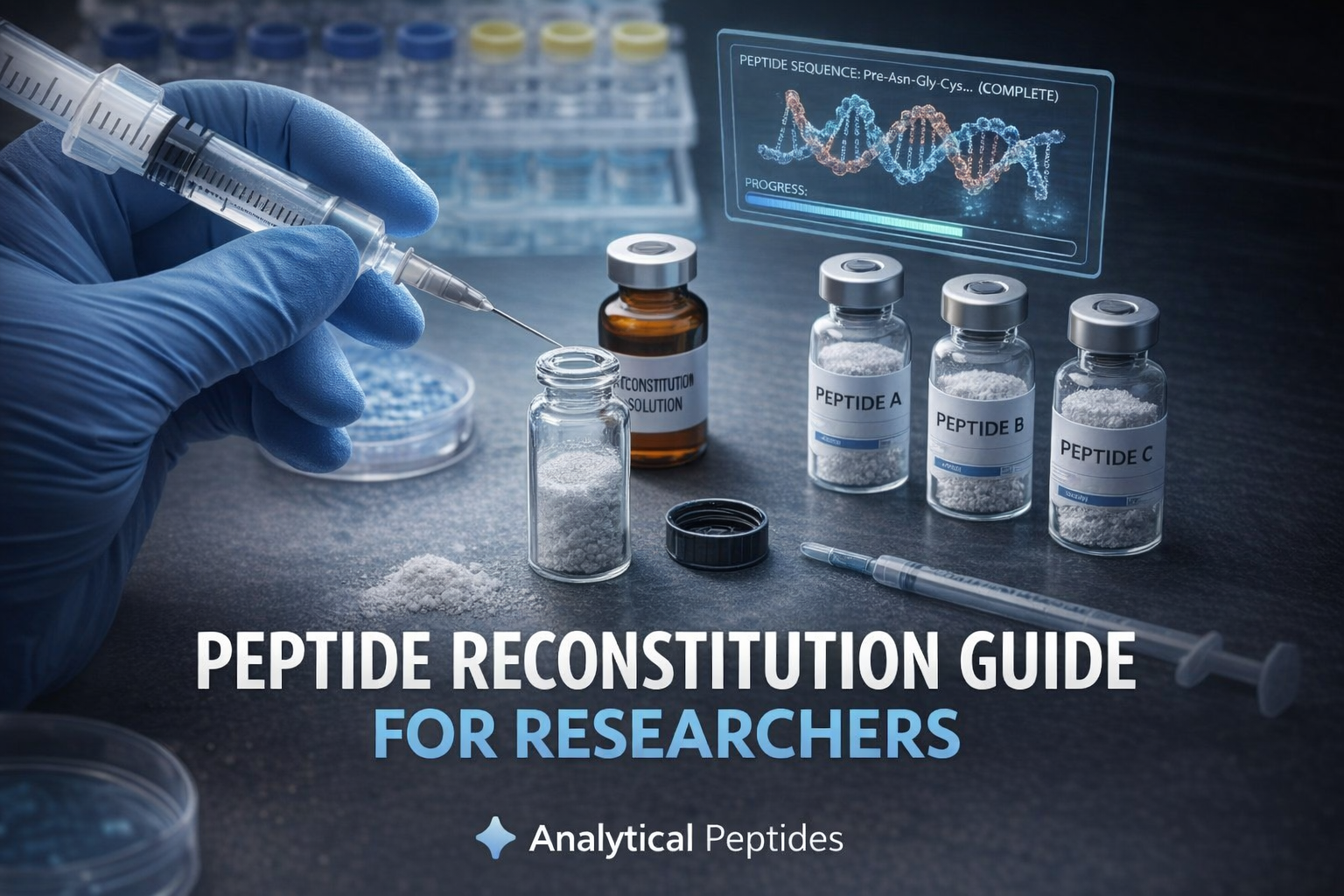
Peptide reconstitution is a fundamental step in laboratory research involving synthetic peptides. It refers to the process of converting a lyophilized (freeze-dried) peptide powder back into a usable liquid solution by adding an appropriate solvent under controlled conditions.
At Analytical Peptides, proper reconstitution is essential for ensuring experimental accuracy, molecular stability, and reproducibility in research workflows involving peptide compounds.
Because peptides are sensitive to environmental conditions such as temperature, pH, and contamination, correct handling during reconstitution is critical for maintaining structural integrity and biological activity in research applications.
1. Understanding Lyophilized Peptides
Most research peptides are supplied in a lyophilized (freeze-dried) powder form. This process removes water under low temperature and vacuum conditions, improving stability and shelf life.
Advantages of Lyophilized Peptides:
- Increased long-term stability
- Reduced risk of degradation
- Easier storage and transport
- Improved consistency for research use
Before use, these peptides must be properly reconstituted into solution form using an appropriate solvent.
2. Essential Materials for Peptide Reconstitution
Before beginning, researchers should prepare a sterile and controlled environment.
Required materials:
- Sterile bacteriostatic water or sterile water for injection
- Alcohol swabs (70% isopropyl alcohol)
- Sterile syringe or pipette
- Vial containing lyophilized peptide
- Clean gloves
- Optional: preservative-containing diluent (for extended stability studies)
Maintaining aseptic conditions is essential to prevent contamination and peptide degradation.
3. Choosing the Correct Solvent
The choice of solvent significantly affects peptide solubility and stability.
Common solvents used in research:
1. Bacteriostatic Water
- Contains a small amount of preservative (benzyl alcohol)
- Suitable for multi-use laboratory handling
- Commonly used in peptide research workflows
2. Sterile Water for Injection
- Free of preservatives
- Suitable for short-term experimental use
- Requires stricter contamination control
3. Acetic Acid Solution (Dilute)
- Used for hydrophobic peptides
- Helps improve solubility in difficult-to-dissolve compounds
4. DMSO (Dimethyl Sulfoxide)
- Used for highly hydrophobic peptides
- Strong solvent, requires careful dilution control
4. Step-by-Step Peptide Reconstitution Process
Step 1: Sterilize the Workspace
Clean the working area with alcohol-based disinfectant and ensure all tools are sterile.
Step 2: Inspect the Vial
Check the lyophilized peptide for:
- Integrity of the vial seal
- Absence of moisture or contamination
- Proper labeling and storage conditions
Step 3: Prepare the Solvent
Draw the required amount of solvent into a sterile syringe.
Step 4: Inject Slowly Into the Vial
Inject the solvent gently against the inner wall of the vial to avoid damaging the peptide structure.
Step 5: Allow Dissolution
Do not shake aggressively. Instead:
- Gently swirl the vial
- Allow the peptide to dissolve naturally
- Avoid foam formation
Step 6: Store Properly
Once fully dissolved, store according to stability requirements (typically refrigeration at 2–8°C for short-term use in research settings).
5. Peptide Concentration Calculation
Accurate concentration is essential for reproducible research outcomes.
Concentration=Diluent (mL)Peptide (mg)
Example:
If 5 mg of peptide is dissolved in 2 mL of solvent:
2mL5mg=2.5mg/mL
Understanding concentration is critical for:
- Experimental consistency
- Dose-response research models
- Receptor binding studies
6. Stability and Storage Guidelines
Peptides are sensitive biomolecules and require proper storage after reconstitution.
Recommended storage conditions:
- Refrigeration at 2–8°C for short-term use
- Avoid repeated freeze-thaw cycles
- Protect from direct light exposure
- Use sterile handling techniques to prevent contamination
Peptide Reconstitution Guide for Researchers & Stability considerations:
- Peptides degrade faster in liquid form than in lyophilized form
- pH and temperature fluctuations can affect structural integrity
- Contamination significantly reduces usability in research settings
7. Common Reconstitution Mistakes in Research
1. Shaking the vial aggressively
This can denature peptide structure and reduce stability.
2. Using incorrect solvent
Hydrophobic peptides may not dissolve properly in water alone.
3. Contamination from improper handling
Introduces microbial risk and degrades sample integrity.
4. Incorrect concentration calculations
Leads to inconsistent experimental results.
5. Improper storage after reconstitution
Accelerates degradation and reduces reliability.
8. Peptide Solubility Considerations
Peptides vary in solubility based on:
- Amino acid composition
- Hydrophobic vs hydrophilic structure
- Charge distribution
- Molecular weight
General guideline:
- Hydrophilic peptides → dissolve easily in water-based solvents
- Hydrophobic peptides → may require acidic or organic solvents
9. Research Applications of Proper Reconstitution
Accurate peptide reconstitution is essential for:
- Receptor binding assays
- Hormonal signaling pathway studies
- Cell culture experiments
- Enzyme interaction research
- Endocrine system modeling
Proper preparation ensures data accuracy and reproducibility in scientific studies.
10. Quality Control in Peptide Handling
Researchers should implement quality control practices such as:
- Visual inspection of solution clarity
- Documentation of concentration calculations
- Batch tracking and labeling
- Temperature monitoring during storage
- Sterility verification in sensitive experiments
These practices ensure consistency across experimental trials.
Importance of Proper Peptide Reconstitution
Peptide reconstitution is not a simple preparation step—it is a critical scientific process that directly impacts research validity and reproducibility.
At Analytical Peptides, proper handling, solvent selection, and storage protocols are essential to maintaining peptide integrity in laboratory environments.